
Window into a World
Window into a world was the first of four visual assignments we received during the audio and visual design minor. The assignment was to create an AV installation under the theme 'Window into a World'. This was to be created from a concept and had the goal of taking the viewer into a different world or experience. Although I had the choice I chose to do this assignment individually.
Process
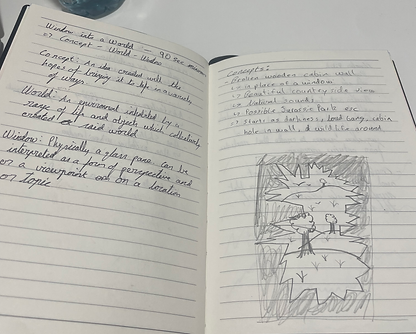
Once I received the assignment I began brainstorming possible ideas. After defining the key words in the brief of this assignment I had this visualisation of the viewer looking through a smashed hole in a cabin wall. My first initial idea was to view a 'Jurassic Park' themed world outside this cabin.
I felt this idea was nice but not as immersive as I'd hoped. I really liked the idea of looking through a broken cabin wall so I thought to place the viewer in the midst of a torrential thunderstorm.
I presented an elevator pitch to my lecturers and classmates who provided feedback. Hendrik told me that I could cut out a broken cabin wall like hole using the laser cutter as my initial plan was to have it be an image covering the footage of this storm.


This was my first version of this project. I overlayed multiple stock videos of thunderstorms and lightning. Simultaneously I used a collection of sounds such as heavy wind, different levels of thunder, heavy rainfall and the sound of a man breathing heavily and screaming.
I used the laser cutter to cut the hole of the cabin wall on some cardboard and attached it to a cardboard box I built myself. There was a chair for the viewer to sit on to look through the hole. As I couldn't hang the projector on the ceiling due to lack of space I improvised by using a stool. This stool however lowered the immersion level as it was in the way of the window for the viewer.
However, Nils grabbed this stools legs to have something to hold on to and actually realised i'd unintentionally made the chair vibrate as the speaker was pushed against the box which was against the stool. He said it really added immersion & interactivity to the installation. I now wanted to elaborate on this further.
I wanted to use my window into a world project in our mini expo as I felt it was the most lacklustre of my projects and I wanted more feedback to improve it. Prior to the mini expo I created a wooden box to further drive home that this took place in a cabin. Nils feedback from the previous installation was something I really considered and I wanted to make immersion and physical interactivity a major aspect so I placed the speaker against the box at the rear and instructed viewers to place their hands on the side of the box. I also added aluminium foil on the sides to have a reflection so the viewer felt fully immersed. To my luck when the speaker would play the audio it actually shook the foil and the wood so much you could hear it shake all around you which further added immersion.

Mini Expo installation

On the left is the final video composition I made to use in my final version of the window into a world installation. Based on feedback I received from my peers and teachers during the mini expo I made some adjustments to the original. These consisted of removing the watermark (obviously), making the jumps around the scene less chaotic as it can be a bother to people and I additionally added some visible rain for further immersion.

In terms of the actual installation itself I removed the back wooden wall and replaced it with a thin white cloth. From this I was able to project the visuals onto this cloth to appear from the other side. What this allowed me to do was place a roof on the box to give the viewer the feeling that they are inside a small room. I placed the speaker on the side this time to not be in the way of the projector and it had the same effect.
Synopsis
The world I wanted viewers to look into is that of a torrential thunderstorm. Specifically they are someone living in a cabin in the countryside who is awoken to a broken hole in their cabin with a raging thunderstorm at their doorstep. Their flight or fight response is activated and they are frozen still in pure shock to this as there is nothing they can do. All that can be done is to watch and hope for the best. All they hear is the clashes of thunder, the hammering of the rain around them and the vibrations being sent through them and the cabin itself.
The take-home I expect viewers to get is the fear in this situation. It is an intense experience for anybody and I want them to feel if this situation were real. Their heart rate increasing, breathing intensifying and the shivers it can send through you. The adrenaline rush this experience can provide is a fun thing in itself and my aim was to give the full 100% immersive experience.
What I Learned
My main takeaway from this project was learning how to create an immersive experience. There's multiple aspects that can be utilised to fulfil this including visuals, audio and physical interaction from a viewer/participant. From class with Nils and Hendrik they helped me understand that it's all about appealing to the individual senses such as touch, sight and hearing and knowing this really does help one improve their installations.
Combining audio and visuals together to immerse a viewer was the first thing I learned. Both rely on the other to be used to their full potential and I have really achieved a good grasp on this fact.
D.I.Y is the next thing. For this project I had to build multiple objects for my installations each varying in some way. It's not something I have much experience with prior to this assignment and I now can say this is not the case anymore. I had a range of items available to me but not everything. With the help of Ronald who really gave me some great ideas I was able to create useful and great objects to immerse a viewer in my installation.
The human senses are a huge part of making an immersive installation like I mentioned above. I didn't get the chance to include smell and taste as part of my installation but Im very happy to say that I used hearing, touch and sight very effectively. Touch plays a major role in this specific installation as I believe it really takes over the viewer and really draws them in. This combined with the audio which shakes the object the viewer has their hand on really just draws them in and focuses their attention to where I wanted them to.
You may also like:
